
In spite of Governor Raghuram Rajan's repeated concerns about inflation, many think there may still be a loosening of stance.

The Indian chemical industry has an output of around USD 80 billion and ranks 12th in the world while the size of the global chemical industry is in the region of USD 3 trillion.

The gauge for the performance of informational technology (IT) stocks soared nearly 5 per cent-most in nearly three years-as growth worries eased following a robust order book posted by bellwether Tata Consultancy Services (TCS). The Nifty IT index rose 4.5 per cent to close at 30,945. This was the biggest single-day gain since September 14, 2020. Industry titan TCS' shares rose 5 per cent to Rs 3,509.

The internals of the food inflation are worrying, given a broad-based uptick across categories that tend to be sticky, such as proteins, and a narrower-than-expected reduction in inflation for vegetables.

In order to boost growth amid some softening of inflation, RBI earlier this month cut the key interest rate by 0.25 per cent. It is scheduled to announce its mid-quarter policy review on June 17.

Global markets trends, inflation, release of industrial output data and quarterly earnings will dictate movement of the equity benchmarks this week, analysts said, adding that volatility might continue amid slew of announcements of macroeconomic data at the global level too. Moreover, foreign fund movement, crude oil prices and trend in rupee would also act as major drivers for the equity market, they added. "The direction of global equity markets along with movement in dollar index and crude oil prices will continue to dominate while inflation numbers of the USA on May 11 and inflation and IIP numbers of India on May 12 will also cause volatility in the market," said Santosh Meena, head of research, Swastika Investmart Ltd.

The broader NSE Nifty after shuttling between 10,451.90 and 10,595.75 finally ended 100.30 points, or 0.96 per cent, higher at 10,582.50.

Global trends, macroeconomic data, and the outcome of the US Fed policy meeting are the major factors that will drive the movement in the domestic equity markets this week, analysts said. "In the upcoming data-centric week, the focus will be on crucial releases, including inflation data from India and the US. "Indian inflation is expected to rise, while US inflation will remain steady.

According to a statement available on the Ministry of Statistics and Programme Implementation website, gross domestic product, consumer price index and index of industrial production will now be released at 5.30 in the evening.

'Given that debt AIFs, by nature, target a higher portfolio return, it is likely to attract investors like HNIs, family offices, etc, looking for a higher yield debt product.'

Output of capital goods -- a proxy for infrastructure investments in the country -- contracted 1 per cent in July

Manufacturing sector, which constitutes over 75 per cent of the index, grew at 5.5 per cent in November compared to a decline in output by 4.6 per cent earlier

Commodity investments can help you diversify your portfolio in asset classes other than equity and debt, says Dwaipayan Bose.

Industrial output rose to nearly three-year high of 6.4% in August.
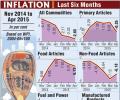
The deflationary trend has bolstered the case for a rate cut by RBI.

According to the commerce and industry ministry data, during April-February 2018-19, the eight sectors recorded a flat growth rate of 4.3 per cent over the same period previous fiscal.

The Reserve Bank of India, which mainly factors in retail inflation to decide its monetary policy, has been tasked by the government to ensure the rate of price rise remains around 4 per cent.

The index of industrial production data released by the government revealed on Friday that the growth in the Rs 32,000 crore (Rs 320 billion) consumer durables was in the negative -- down 3 per cent as against 9 per cent in October 2007. On the other hand, the durables sector had contributed to the industrial output rebound in the months of July (12.3 per cent ) and September (13.1 per cent).
The wholesale price-based inflation declined to over two-year low of 3.85 per cent in January on easing prices of manufactured items, fuel and power, even though food articles remained expensive. This is the ninth straight month of decline in the rate of wholesale price-index (WPI) based inflation. The WPI inflation was 4.73 per cent in January and 13.43 per cent in February, last year.
The Index of Industrial Production for the same month last year stood at 12 per cent. For the first half of the current fiscal (April-September 2007) too, IIP slipped to 9.2 per cent against 11.1 per cent in the corresponding period a year ago, an official release said on Monday. During September, the manufacturing sector growth decelerated to 6.6 per cent as compared to 12.7 per cent in the same month last year.

With natural gas and cement showing decline in production, the growth of eight core infrastructure industries slowed down to 5.3 per cent in May against 7.4 per cent a year ago.

Investors should view any bounce-back in bank stocks as an opportunity to exit the pack, analysts suggested, as the worst may not be over yet. The recent quarterly results of HDFC Bank and Axis Bank disappointed the Street, triggering a marketwide selloff by foreign institutional investors, especially in banking counters. While HDFC Bank, which was the anchor for the market correction during the past week, ended 2 per cent higher amid short covering on Wednesday, Axis Bank's shares settled 3 per cent lower.

'We expect the bull-market phase to still persist, but now led by large-caps which offer better valuation and benefit from FII inflows.'
'We expect continued pressure on midcaps, but any sharp correction looks unlikely from here on.'

The pharmaceuticals sector is expected to post a revenue growth of around 13.5 per cent and a net profit growth of 30.3 per cent for the third quarter of 2023-24 (FY24), riding on the approval for niche drugs in the US market, fall in raw material prices and correction in shipping rates. In the healthcare segment, hospitals are expected to post revenue growth of 13 per cent during the coverage, while net profit growth would be around 37 per cent, ICICI Securities said in a note. However, the performance may not be comparable on a sequential basis due to the offset of the festive season in Q3FY24, the analysts noted.

The wholesale price-based inflation declined to a 21-month low of 5.85 per cent in November on easing prices of food, fuel and manufactured items. After remaining in double digits for 19 months, the wholesale price index (WPI) based inflation declined to 8.39 per cent in October. The inflation was 14.87 per cent in November 2021. "Decline in the rate of inflation in November 2022, is primarily contributed by fall in prices of food articles, basic metals, textiles, chemicals & chemical products and paper & paper products as compared to the corresponding month of the previous year," the commerce and industry ministry said on Wednesday.

Capital goods, a barometer of investments, showed a sharp increase in output by 14.6 per cent in January, 2018 as against a decline of 0.6 per cent year ago.
The core industries that also include coal, electricity, cement, petroleum refinery products and finished steel, and carry 37.9 per cent weight in the Index of Industrial Production, had grown by 5.8 per cent in May last year.

The domestic benchmark indices - the S&P BSE Sensex and the National Stock Exchange Nifty50 - had lost close to 1.5 per cent in three days recently before gaining slightly. Notwithstanding weakness and volatility, the Nifty50 has managed to hold on to the 18,000 mark, while the Sensex has managed to stay above the 61,000 level. The performance of the stocks that comprise these front-line indices remains polarised.

The statistics ministry has proposed the new base year for GDP and IIP as 2017-18 while for CPI it will be 2018.

Bolstered by bullish investor sentiments, India witnessed companies mopping up a whopping $9.7 billion through initial share sales in the first nine months of 2021, the highest amount for the nine-month period in two decades, says a report. As many as 72 initial public offerings (IPOs) hit the stock market during the January-September period this year in India and strong sentiments were visible in the global markets as well, according to leading consultancy EY. EY, in its latest report, said the global IPO market continued to boom through Q3 2021 resulting in the most active third quarter by deal numbers and proceeds in the last 20 years.

The wholesale price-based inflation eased to a 29-month low of 1.34 per cent in March on easing prices of manufactured products and fuel items, even though food articles turned expensive.


...and getting GDP to measure India's data economy, recommends Ajit Balakrishnan.

During April-February, industrial output grew at 2.6 per cent compared with a growth of 2.8 per cent in the year-ago period.

Don't be surprised if growth in the second half of the financial year drops below 4%, which is where it was in the year before the pandemic, warns T N Ninan.

The mutual fund (MF) industry had an action-packed 2023 as it tackled the scrapping of tax benefits for debt fund investors and surging flows into equity funds.

The wholesale price-based inflation eased for the eighth consecutive month to 4.73 per cent in January on easing prices of manufactured items, fuel and power. The wholesale price-index (WPI) based inflation rate was 4.95 per cent in December 2022 and 13.68 per cent in January 2022. Inflation in food articles, however, rose to 2.38 per cent in January, from (-) 1.25 per cent in December, 2022.

Adani Enterprises became the fourth listed company of Gautam Adani Group to cross Rs 4 trillion market capitalisation (market cap), as the stock hit a new high on the BSE in Tuesday's intra-day trade. At 01:24 pm; with Rs 4.04 trillion market cap, Adani Enterprises stood at number 15th position in overall market cap ranking on the BSE, data shows. Adani Transmission is at top of the group companies list, with market cap of Rs 4.48 trillion, followed by Adani Total Gas (Rs 3.96 trillion), and Adani Green Energy (Rs 3.72 trillion).

The 30-share index ended higher by 481.16 points or 1.91 per cent at 25,626.75 -- its highest closing since January 1.

Meaningful market share would go to those who have the distribution strength to push their products, such as banks.
